
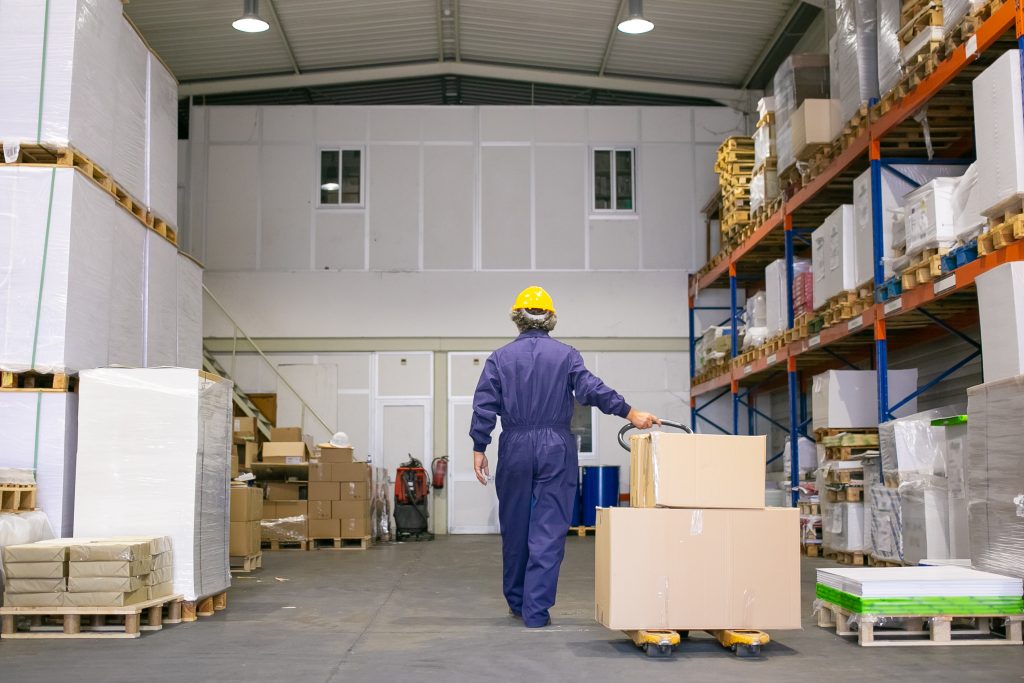
This is the checklist we work from, organised by how often each task actually needs doing rather than by area. Copy it into your CMMS, hand it to a contractor as a scope sheet, or use it to check that the bid in front of you covers the whole building.
Two things before the lists. First, frequency depends on what you handle: a building moving dusty product or running heavy forklift traffic needs the daily list done properly and the monthly list pulled forward. Second, the tasks marked Specialist need equipment a general janitorial crew will not have on the van, mainly ride-on scrubbers and lifts.
Daily warehouse cleaning checklist
These are the tasks that keep the building safe and compliant day to day. Most sit with an in-house team or a nightly janitorial contract.
| Task | Zone | Why it matters |
| Clear aisles and walkways of pallets, wrap and banding | Floor | Direct OSHA exposure, blocked egress |
| Sweep or dust-mop main traffic lanes | Floor | Slip risk, dust transfer onto product |
| Spot-clean spills immediately, place wet floor signage | Floor | Slip, trip and fall is the most common warehouse citation |
| Empty waste and recycling stations | All | Pest harbourage, fire load |
| Clean and restock restrooms | Welfare | Required under OSHA 1910.141 |
| Wipe break room surfaces, tables and appliances | Welfare | Pest control, staff retention |
| Clear the dock apron of debris and shrink wrap | Dock | Trip hazard, drain blockage |
| Check and clear fire exits and extinguisher access | All | Cited routinely, costs nothing to check |
| Empty forklift battery area spill trays | Charging | Acid exposure, corrosion |
Weekly warehouse cleaning checklist
| Task | Zone | Notes |
| Machine scrub main aisles and high-traffic floor | Floor | Specialist if the building is over about 50,000 sq ft |
| Clean dock levelers, pits and bumpers | Dock | Pits collect organic debris and standing water |
| Wipe dock door tracks and seals | Dock | Extends seal life, reduces air loss |
| Detail restroom floors, partitions and fixtures | Welfare | Beyond the daily wipe-down |
| Clean interior glass, office partitions and doors | Office | First impression for visiting customers |
| Vacuum office carpet and entry matting | Office | Matting is the main soil entry point |
| Wipe down forklifts and powered equipment | Equipment | Operators inspect what looks maintained |
| Inspect and clear floor drains | Floor, dock | Blocked drains cause the next spill to spread |
Monthly warehouse cleaning checklist
| Task | Zone | Notes |
| Full machine scrub of the entire slab, not just aisles | Floor | Specialist. Includes under racking where reachable |
| Degrease forklift lanes and turning points | Floor | General detergent will not lift rubber and hydraulic residue |
| Hand-detail floor edges, corners and column bases | Floor | Machines cannot reach these, ever |
| Wipe racking uprights and beam faces at picking height | Racking | Dust transfers onto cartons here first |
| Clean light fixtures at accessible heights | Overhead | Light loss from dust is real and measurable |
| Deep clean break room appliances inside and out | Welfare | Pest prevention |
| Pressure wash the dock apron where drainage allows | Exterior | Check local stormwater rules before washing to drain |
| Clear and clean the battery charging area floor | Charging | Neutralise before cleaning |
Quarterly and annual checklist
This is the work that almost never appears in a recurring janitorial contract, and it is the reason buildings book a one-time deep clean.
| Task | Frequency | Notes |
| High dusting of joists, beams and conduit | Annual | Specialist. Lift and HEPA vacuum, never compressed air |
| Clean sprinkler pipework and heads | Annual | Specialist. Heavy dust can affect activation |
| Clean HVAC diffusers, returns and unit heaters | Quarterly | Dust here recirculates across the whole building |
| Full racking wipe-down including wire decking | Annual | Bring forward before any customer or certification audit |
| Clean high-level light fixtures | Annual | Combine with the high dusting visit to share the lift cost |
| Deep clean dock pits and seals | Quarterly | Pest harbourage risk if skipped |
| Strip, reseal or recoat the slab where specified | As needed | Specialist. Depends on floor type and condition |
| Clear and clean the mezzanine and elevated platforms | Quarterly | Routinely forgotten until an audit finds it |
| Remove accumulated pallets, wrap and obsolete stock | Quarterly | Fire load and OSHA 1910.176(c) exposure |
Pre-audit checklist
If you have an AIB, SQF, customer or insurance audit with a date on it, work backwards from the date and cover these in order. Leave a buffer night.
- Overhead first, always. Dusting the steel after scrubbing the floor means doing the floor twice. Everything works top-down.
- Sprinkler heads and pipework. Visible accumulation is a fast finding and an easy fix.
- Racking, including wire decking and the top beam faces that nobody looks at from the floor.
- Full slab scrub with degreaser through the lanes. Auditors look at the floor under the racking, not just the aisles.
- Dock pits, seals and the apron. Standing water and organic debris in pits is a pest finding.
- Restrooms, break rooms and locker areas detailed rather than wiped.
- Waste, wrap and pallet accumulation removed from site, not relocated to a back corner.
- Cleaning records assembled. For food-grade audits the documentation is itself assessed: what chemistry, what dilution, what frequency, signed by whom.
What OSHA actually requires
No OSHA standard sets a cleaning frequency for a warehouse. What the standards require is an outcome, and three are worth knowing by number:
- 29 CFR 1910.176(c) requires storage areas be kept free from accumulation of materials that constitute hazards from tripping, fire, explosion or pest harbourage.
- 29 CFR 1910.22 requires places of employment, passageways and storerooms to be kept clean, orderly and sanitary, and walking surfaces to be maintained free of hazards.
- 29 CFR 1910.141 covers sanitation: restrooms, washing facilities and waste disposal.
In practice, citations follow the consequence rather than the dust. A blocked aisle, a slip on a contaminated slab, a pest problem traced to a dock pit. A documented cleaning schedule matters less as a compliance artefact than as evidence you were managing the hazard.
How to turn this into a scope sheet
If you are putting the work out to bid, the checklist above converts directly into something contractors can price line by line:
- Decide which frequency column your in-house team covers and which you are buying.
- List the tasks you are buying, with the building’s square footage, clear height and floor type at the top.
- Note what stays loaded during the work and what shift window is available.
- Send the same sheet to every bidder. A single number for “warehouse cleaning” cannot be compared against anything.
- Ask each one what happens to the dust from the overhead work. It separates the serious contractors quickly.
If you are not sure which tasks belong in which bucket for your building, our guide to what warehouse cleaning covers goes through the six zones in more detail, and our pricing page shows what each scope tends to cost in metro Atlanta.
Frequently asked questions
How often should a warehouse floor be scrubbed?
Main aisles weekly in most buildings, and the full slab monthly to quarterly. Heavy forklift traffic or dusty product pulls both forward.
How often does warehouse high dusting need doing?
Annually for most distribution buildings, twice yearly for food-grade, and immediately if sprinkler heads are showing visible accumulation or you have an audit booked.
What is the correct order to clean a warehouse in?
Top down, every time. Overhead steel and sprinkler pipework first, then racking, then the slab, then the dock. Cleaning the floor before the overhead work means cleaning it twice.
Can my nightly cleaning crew do the monthly and annual tasks?
The monthly list is borderline and depends on whether they have a scrubber sized for your building. The annual list is not: work above 25 ft needs a lift, fall protection and certified operators.
Should compressed air be used for high dusting?
No. It moves the dust onto your product and your floor rather than removing it, and in some buildings it creates a combustible dust concern. HEPA vacuum collection is the correct method.
Need the specialist tasks covered?
We handle the monthly, quarterly and annual columns as a single scheduled visit across metro Atlanta, with no contract attached. Most buildings are finished in one to three nights.